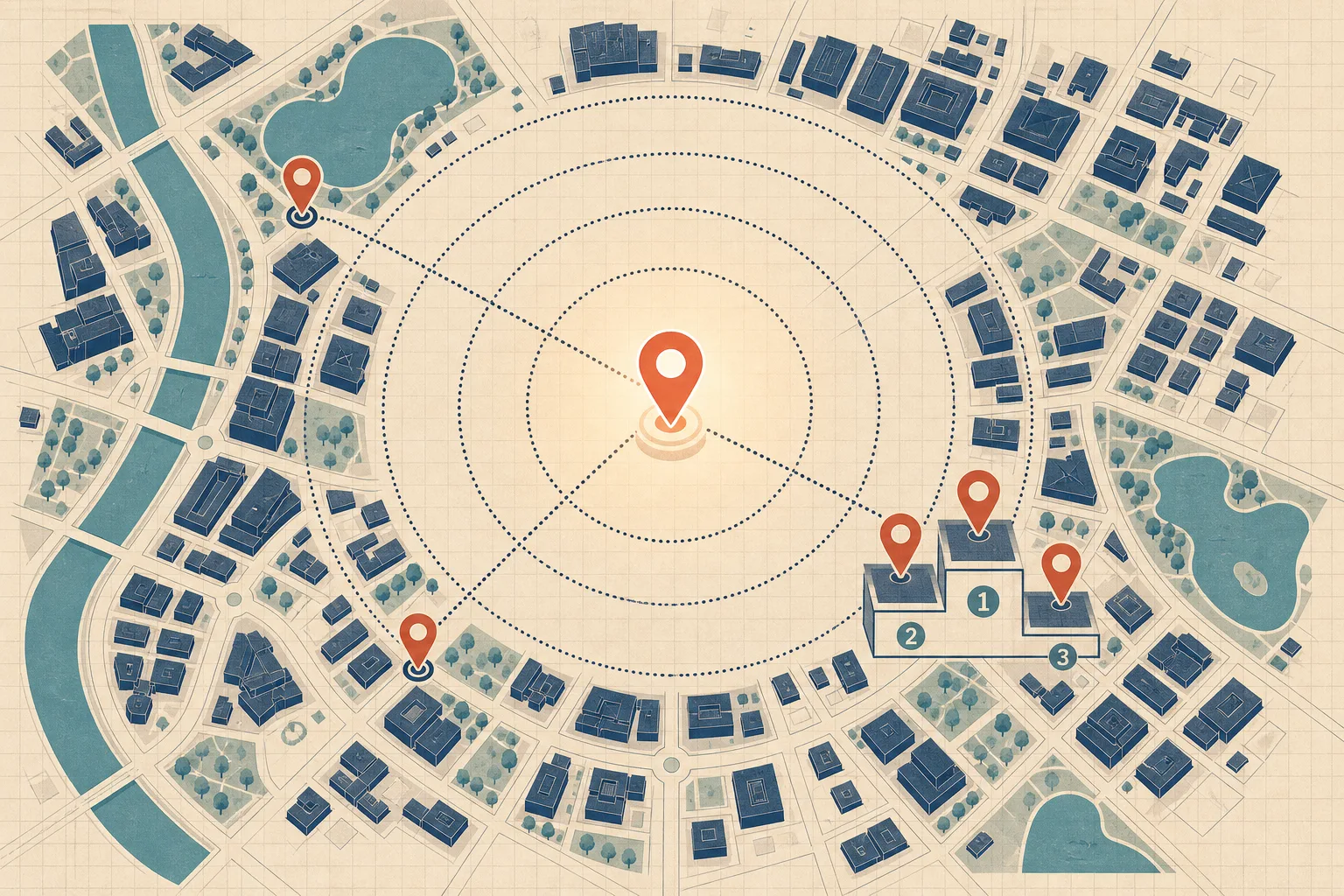
- Google’s own documentation names three blended factors: relevance, distance, prominence. Distance is heavily weighted and outside your control — this one fact explains most local ranking outcomes and every honest “it depends.”
- The local pack and organic results are two different systems. Winning one doesn’t win the other; a complete strategy works both.
- What you control: relevance (accurate categories and profile), prominence (reviews, links, citations, brand), and your organic-site strength. Measure with geo-grid checks, not single-location rank checks.
- Nobody can guarantee #1 — not ethically and not technically. Anyone who does is selling you something.
The anatomy of a local search result
Search “emergency plumber” from your phone and the page assembles itself in layers: sponsored results, an AI Overview or map block, the local pack (map plus ~3 businesses with ratings and hours), then classic organic results — directories, articles, and the websites of businesses that rank organically.
Two different ranking systems are at work here. The local pack is driven by your Business Profile signals blended with distance. The organic results below it are classic web ranking applied to websites. A business can appear in both, either, or neither — which is why local SEO has two halves (see the technical site-side guide).
The three factors, honestly
Google’s published framing (How to improve your local ranking) describes local ranking as a blend of:
1. Relevance — how well your profile matches what was searched. A precise primary category, real services listed, accurate attributes: these make you legible for the right queries. This is the most controllable factor, and it’s why the GBP guide’s “fill the fields that matter” table is mostly relevance work.
2. Distance — how far you are from the searcher (or the location they specified). If the searcher doesn’t type a location, Google uses their device location. This is the factor that breaks people’s hearts: a superb plumber two neighborhoods away may simply not appear against an adequate one around the corner. There is no compliant tactic that overcomes distance for a searcher who is genuinely nearer a competitor. What you can do: win your own radius, expand legitimately with more locations (multi-location guide), and win the organic and directory results underneath the pack.
3. Prominence — how well-known and well-regarded Google believes you are, online and off. Review count, score and recency are prominence signals (Google says so plainly); links, citations (consistent NAP across the web — guide), directory presence, and “real-world” notability feed it. SEO effort aimed at anything usually aims here, because it’s the factor with the most levers.
The organic half: your website still matters
For local businesses, organic results are the consolation prize that isn’t: queries with research intent (“how much does drain cleaning cost”), queries outside your radius, and the AI-driven answer surfaces all draw on your website. Site-side strength — fast mobile pages, clear service and location content, sound technical fundamentals — also supports the profile side; Google’s systems read both. The full site-side discipline lives in the technical & on-page guide.
Geo-grid tracking: seeing your real visibility
Because distance varies results by searcher location, a single rank check is a single sample of a landscape. Grid tracking runs your target query from many points across your service area and plots the results as a heatmap: strong near the shop, thinning at the edges — your true service area as Google sees it.
You can approximate this manually (search from mapped points with location overrides) or with tracker tools that do it programmatically. Either way, the discipline matters more than the tool:
- Track a handful of commercial queries, not fifty vanity ones.
- Read the shape (where you’re strong/weak) rather than obsessing over #2 versus #3.
- Re-measure monthly; local packs are volatile week to week.
Diagnosing “why am I not ranking?”
Work it in order, evidence before effort:
- Is your profile complete, accurate, and in good standing? (Suspensions and quality issues override everything — GBP guide.)
- Is it distance? Check from next door to your business. If you rank well near and fade with distance, you don’t have an SEO problem — you have a geography problem, and the answer is legitimately expanding (or accepting the radius).
- Is it relevance? Wrong or missing primary category; services not listed; query categories you’re simply not registered for.
- Is it prominence? Competitor review advantage is visible at a glance. Compare review count/recency, then look at their link and citation profile.
- Is it the website? If competitors appear in organic and you don’t, fix the site half too.
The audit checklist walks all five in audit order.
What this means for working with SEOs
Ask any prospective provider: which of the three factors are you improving, and how will we measure it? Competent answers sound like this guide — specific levers, geo-grid measurement, honest statements about distance. Incompetent or predatory answers sound like “we have a special relationship with Google” (nobody does) or “guaranteed page one” (see the FAQ above). Our editorial policy applies the same standard to our own claims: we tell you what’s primary-source verifiable, what’s practitioner evidence, and what’s contested.
Sources and evidence notes
- Relevance/distance/prominence framing: Google Business Profile Help — primary.
- Review signals as ranking input: same Google documentation — primary. Magnitude and weighting: practitioner studies (Whitespark’s annual local ranking factors survey and similar) — survey-based practitioner evidence, directional only.
- Distance dominance in dense categories: practitioner consensus, moderate confidence, contested in edge cases.