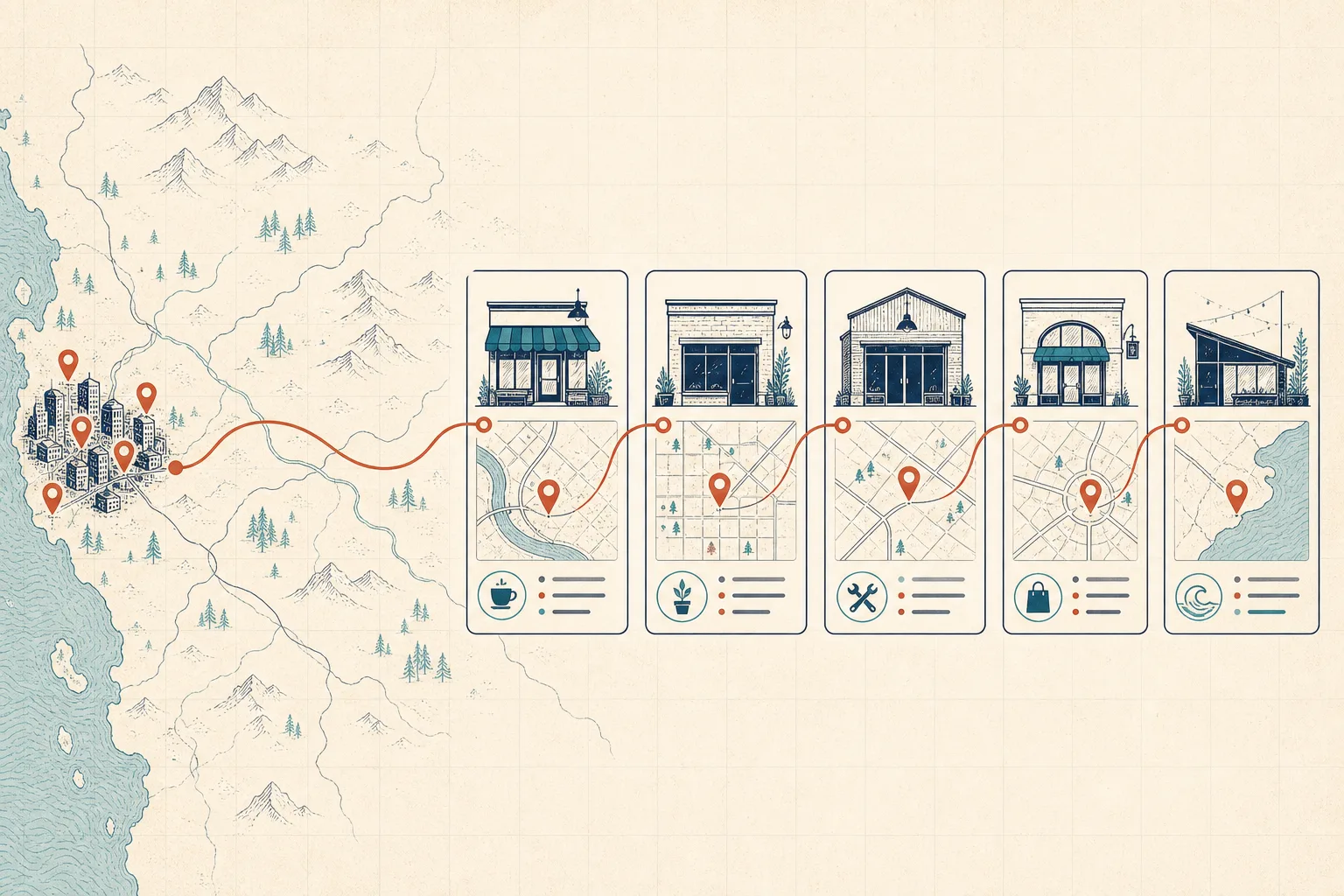
- Multi-location local SEO fails structurally, not tactically: thin stamped pages, duplicate profiles, drifting NAP, and no per-location visibility. Fix the structure and most “ranking problems” shrink.
- Location pages pass one test: would this page still be worth reading if the brand name were removed? Staff, hours, local proof, real photos — or don’t publish it.
- One domain, organized
/locations/structure, one profile per real location, category and NAP governance across all of them. - Report per-location with grid-shaped visibility tracking, not one blended average that hides the problem child.
Where multi-location goes wrong
Scale multiplies whatever you actually have. If you have one accurate profile, you get N accurate profiles. If you have a thin page template and sloppy data, you get N thin pages and N sloppy profiles — plus new failure modes single-location businesses never meet:
- Doorway drift: a city-template stamped faster than unique content can be written (the doorway line).
- Profile sprawl: duplicates, legacy listings from acquired businesses, and profiles created for “service areas” that aren’t real locations.
- NAP entropy: each location’s data drifting independently across the citation ecosystem (cleanup discipline).
- Governance vacuum: nobody owns categories, hours, and holiday updates for all locations at once.
The rest of this guide is the working structure that prevents each.
The location page that earns its place
Start from the honest test: would this page be worth a reader’s time if the brand name were removed? A page that’s worth reading carries:
- The real specifics of that location: staff names and photos (where appropriate), direct phone, hours including this location’s quirks, parking/entrance/transit notes, accessibility details.
- Local proof: work done in that area, location-relevant reviews referenced naturally, community involvement (sponsorships, chambers, teams) that’s verifiable.
- Location-specific FAQs (does this branch handle X? do you serve Y suburb from here?) — the questions your front desk actually answers.
- A unique photo set — not the brand’s stock library with a different header.
What it does not carry: 500 words of “Welcome to [Brand] [City], the best [service] in [City], proudly serving [City] and surrounding areas of [City]” — the template fingerprint Google’s doorway guidance targets and customers can smell at first scroll. If you can’t yet write the real version, publish nothing and let the profile carry the location until you can.
URL structure: /locations/{city-slug}/ on the main domain (see FAQ on microsites — don’t). Each page links to its own profile, its own GBP-cited reviews, and its service context; services stay on /services/ pages that all locations’ pages reference, so you’re not duplicating service copy per city.
Business Profiles at organization scale
- One profile per real location. Staffed, customer-facing, signposted. Virtual offices, co-working desks, and “locations” that exist to farm map presence are guideline violations that risk the whole account, not just one listing (GBP guide for the single-listing foundations).
- Naming discipline: the brand’s real name, consistently. Location descriptors only when the real-world signage genuinely uses them.
- Category consistency: same primary category across locations unless a location genuinely differs (a location with a walk-in clinic inside, say). Categories should describe each location’s actual operation — drift here quietly splits your relevance signals.
- Account structure: manage profiles under an organization/manager structure so permissions, ownership, and audit trails are centralized — not under a departed employee’s personal login or an ex-agency’s account. Audit who has access annually.
- Deduplication: acquired or legacy locations need merge/closure handling — duplicates split reviews and signals exactly like they do for single businesses.
NAP and citation governance
The citations guide workflow, per location, with one addition at scale: a canonical data table (one row per location: exact name, phone, address, hours, URL of its page) that every system — site, profiles, directories, print, ad landing pages — copies from. Drift starts wherever someone retypes instead of copy-pasting. Aggregator fixes propagate to many downstream directories at once, which is where managed citation services genuinely earn their fee for multi-location brands.
Internal linking and authority flow
- Home → locations hub → each location (flat, ≤3 clicks).
- Each location page links up to the services it performs and laterally to genuinely nearby locations (“Also serving [adjacent area] from our [next-town] branch”) — useful to customers, honest to crawlers.
- Service pages link down to the locations offering them.
- Profiles link to their own location pages (not the homepage) — matching entity to entity.
Per-location measurement
Blended averages hide the problem location. Track per-location:
- Profile metrics per listing: calls, direction requests, website clicks (profile analytics) — the operational truth of each branch.
- Grid visibility for each location’s commercial queries in its own radius (geo-grid discipline) — the honest picture of each branch’s local presence.
- Organic sessions to each location page, plus its conversion events.
- Review velocity per location — the leading indicator of both ranking prominence and operational problems (a branch whose reviews stop usually has a manager problem, not an SEO problem).
Monthly, one page per location, compared longitudinally. The audit workflow: duplicate Sections 1–3 of the audit checklist per location and run them on rotation.
Sources and evidence notes
- Doorway-page policy, profile-per-location and naming guidelines: Google Search Central spam policies, Business Profile guidelines — primary.
- Organization-level profile management: Google’s Business Profile Manager documentation — primary.
- Grid tracking methodology: practitioner tooling (e.g., Local Falcon-style geo-grid) — practitioner-established method, directional data.